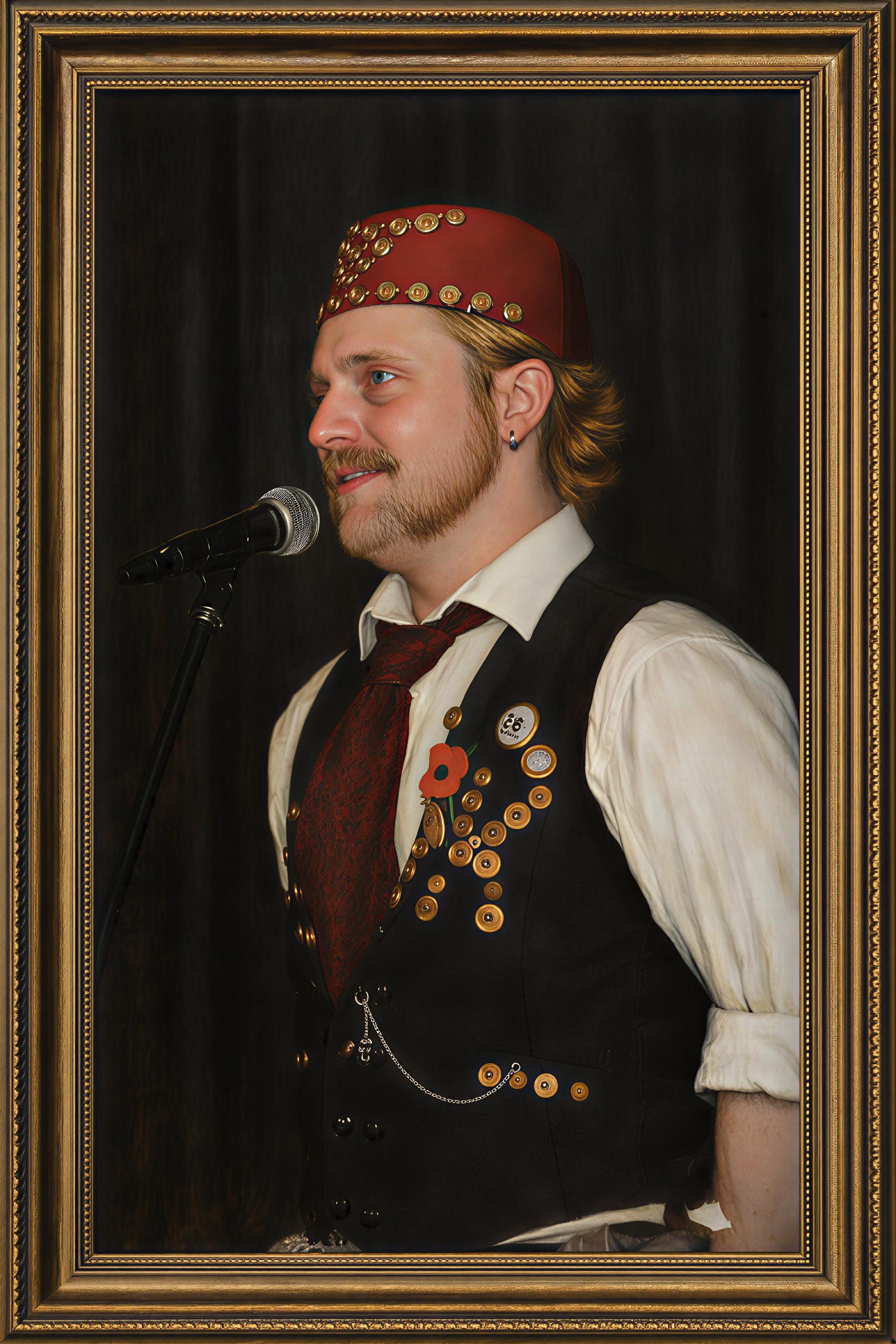
About Arthur Foot III
Oh, hello there.
Do forgive the suddenness of my appearance. One never quite knows where one might encounter the public these days. Drawing rooms, railway platforms, tea gardens, or heaven preserve us the internet.
Allow me to introduce myself with the decorum befitting a gentleman of refinement.
I am Arthur Foot the Third, sometimes known in certain circles of exquisite taste as Lord Loverduc, and I first drew breath within the sonorous and ecclesiastically approved radius of Bow Bells in that remarkable and occasionally fragrant metropolis known as London.
Some years past now, of course. One does not dwell upon numbers when one has cheekbones such as mine.
Fortunately, and I say this with the profoundest gratitude to Providence and a well-timed family carriage, I was swiftly removed from the more aromatic districts of the capital and conveyed to the gracious grounds of my family’s estate in Kent, that most exquisite and civilised of counties.
There I was raised in the manner one might expect of a gentleman destined for distinction.
Picture it, if you will.
Rolling orchards bending beneath the weight of apples of superior breeding.
Sunlight filtering through ancient oaks that have witnessed centuries of impeccable manners.Oh, hello there.
Do forgive the suddenness of my appearance. One never quite knows where one might encounter the public these days. Drawing rooms, railway platforms, tea gardens, or heaven preserve us the internet.
Allow me to introduce myself with the decorum befitting a gentleman of refinement.
I am Arthur Foot the Third, sometimes known in certain circles of exquisite taste as Lord Loverduc, and I first drew breath within the sonorous and ecclesiastically approved radius of Bow Bells in that remarkable and occasionally fragrant metropolis known as London.
Some years past now, of course. One does not dwell upon numbers when one has cheekbones such as mine.
Fortunately, and I say this with the profoundest gratitude to Providence and a well-timed family carriage, I was swiftly removed from the more aromatic districts of the capital and conveyed to the gracious grounds of my family’s estate in Kent, that most exquisite and civilised of counties.
There I was raised in the manner one might expect of a gentleman destined for distinction.
Picture it, if you will.
Rolling orchards bending beneath the weight of apples of superior breeding.
The gentle clink of porcelain teacups carried across lawns trimmed with almost military precision.Within this Arcadian sanctuary I grew rich, educated, cultured, and fully aware from a delightfully early age of my natural superiority to the standard plebeians that populate this fair isle.
Tutors were summoned.
Languages were inflicted upon me.
Poetry was encouraged.
And posture. My word, the posture.
My upbringing is writ upon me as surely as if it had been engraved upon my person with a particularly tasteful monogramming iron.
People see me, you understand, and they know.
They do not need to ask.
They simply look upon the bearing, the carriage, the noble tilt of the head, and something stirs within them.
“Kent,” they whisper inwardly.
“Yes,” their souls reply. “Quite so.”
It is a burden one carries with dignity.
And yet, history, dear reader, is a mischievous playwright.
For despite my impeccable breeding, my refined sensibilities, and the quiet expectation that I might one day become a mildly distinguished gentleman who writes melancholy verses about hedgerows, fate had other plans.
Plans involving London.
Plans involving music halls.
Plans involving applause, gaslight, uproarious laughter, and occasionally fruit of questionable freshness hurled from the gallery.
And perhaps most significantly of all, plans involving my extraordinary Partner-in-Rhyme, the incomparable, irrepressible, and occasionally alarming Miss Tilly Maydme.
How, you ask, does a gentleman of Kentish refinement find himself upon the riotous stages of the London music halls?
How does a poet of aristocratic inclination become half of a steam-powered music-hall double act?
How did I tumble from orchard to orchestra pit, from drawing room to dressing room, from genteel verse to ribald rhyme?
My dear friends, the tale is too strange for ordinary prose.
Allow me instead to explain the whole regrettable affair.
In poem form...
When Arthur Met Tilly.
Now this is the story all about how
I ended up an performer in old London town
This won’t take long, just sit right there
And learn how I became one of the famous Cogkney pair
In the best parts of Kent, not born but raised
In a mansion was where I spent most of my days
Riding my horses, playing the fool
Educated in the finest of schools
Then my father died, and that was no good
I ended up becoming the young Lord Luvva-Duk
And although I knew I’d be terribly bored
Mater said ‘get yourself off to the House of Lords’
I went to the city and took a small flat near to
The streets that held all the wonderful theatres
The smell of the greasepaint was wondrous and rare
And I knew right then that I belonged there
I went out with an actress (actually seven or eight)
And I knew for certain that I had to defy Mater
I took took to the stage with my poetry silly
And there I met a cockney sparrow named Tilly
(And the rest, they say, is history.)